EnigmatlasENIGMATLAS
Out-of-Place ArtifactsUnsolved

The Voynich Manuscript

An undeciphered manuscript believed to date from the 15th century, composed of an unknown writing system and bizarre botanical illustrations that have baffled cryptographers for over 600 years.
Location:
Yale University (current location), Italy (origin)
Date Occurred:
1404
Status:
Unsolved

Overview

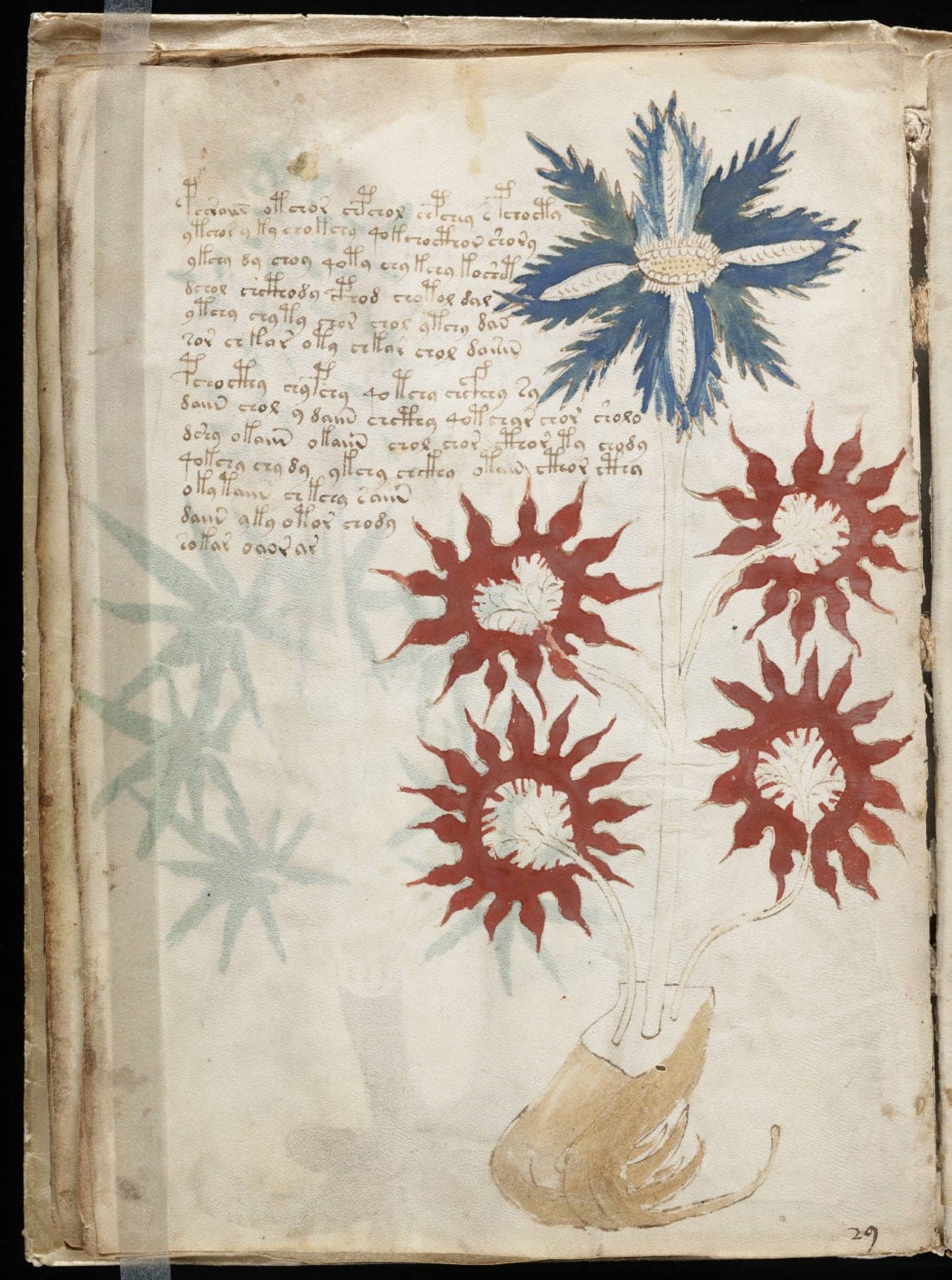
The Voynich Manuscript is a parchment codex of approximately 240 pages written in an unknown script called "Voynichese." Radiocarbon dating has confirmed that the vellum was produced between 1404 and 1438. It was discovered in 1912 by Wilfrid Voynich, a Polish-American book dealer, at a Jesuit college in Italy and named after him.

Key Features

Script and Language

The text is written left to right using approximately 20-25 distinct character symbols. Statistical analysis shows that letter frequency patterns resemble those of natural languages, yet they match no known language. Repetition patterns and vocabulary distribution follow Zipf's law, suggesting the text is not random gibberish.

Illustrations

The manuscript contains drawings of plants, astronomical diagrams, human figures, and pharmaceutical-looking charts. Many botanical illustrations do not match any known plant species and have been interpreted as imaginary organisms. The astronomy section includes circular diagrams resembling zodiac signs and constellations.

Proposed Hypotheses

  • A herbal medicine text written in a lost natural language of medieval Europe
  • A deliberately encrypted document (e.g., attributed to Roger Bacon)
  • An elaborate hoax consisting of meaningless strings as an intellectual fraud
  • A philosophical or mystical text written in a constructed language

AI Analysis

Scientific Explanation

Radiocarbon dating confirms the Voynich Manuscript's vellum dates to the early 15th century, ruling out modern forgery. Statistical patterns in the script exhibit characteristics of natural language, but no decipherment has succeeded. Recent AI-assisted analyses have advanced pattern recognition but have not achieved full translation. The hoax theory persists, but it remains questionable whether anyone at the time could have deliberately constructed strings mimicking the statistical properties of natural language.

Alternative Theories
  • The manuscript may be a practical medical text written in a personal shorthand system devised by a medieval herbalist, with the script being a form of private notation rather than a cipher.
  • The text may employ a double encryption method such as a Cardan grille cipher, and the grille (key) has been lost, rendering it unreadable.
  • The manuscript may be a sophisticated hoax with statistically structured text, created using a mechanical method such as a rotating cipher disk to generate plausible-looking strings.
Credibility Assessment

Credibility 8/10 — The manuscript itself is real, and its dating has been scientifically confirmed. The central question of whether the script represents a genuine language or cipher remains unsolved. The fact that it has resisted decipherment for 600 years suggests it is neither a simple cipher nor a simple hoax.