A hammer allegedly found embedded in 400-million-year-old rock near London, Texas in 1936. Young Earth creationists claim it disproves evolution, but geologists offer a far simpler explanation.
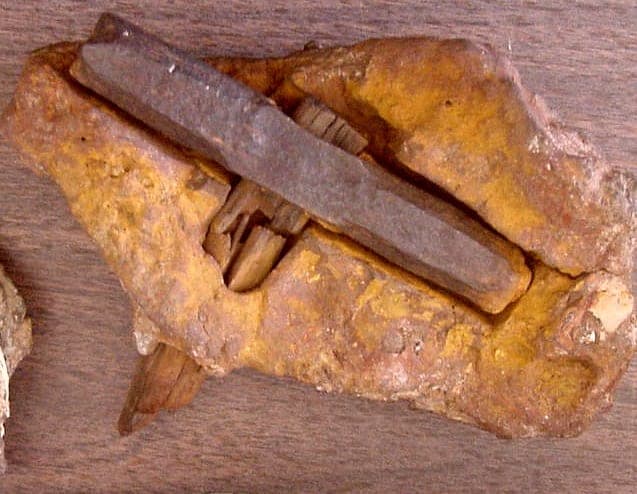
June 1936. Near the small town of London, Texas, Max Hahn and his wife Emma were walking along Red Creek when they noticed what appeared to be a wooden handle protruding from a rocky ledge.
Intrigued, they took the rock home. When they later cracked it open, they found the head of an iron hammer, its wooden handle partially coalified, firmly encased in a nodule of limestone.
The limestone is identified as Ordovician—formed roughly 400 to 500 million years ago. If the hammer was embedded at the time the rock formed, it would be the most extraordinary archaeological discovery in history, predating not just humanity but most complex life on Earth.
But is that really what happened?
The London Hammer was purchased in 1983 by Carl Baugh, a young Earth creationist who founded the Creation Evidence Museum in Glen Rose, Texas. The hammer has been the museum's star exhibit ever since.
Baugh's argument is straightforward. This hammer was made before the Great Flood described in Genesis. Its presence in ancient rock proves that conventional geological dating is wrong and that the Earth is far younger than mainstream science claims.
The claim has been embraced enthusiastically by the young Earth creationist community, and the London Hammer has become an iconic out-of-place artifact in the anti-evolution movement.
Geologists, however, see something far more mundane.
The key concept is concretion—a well-documented geological process in which dissolved minerals precipitate out of groundwater and re-solidify around an existing object. Ancient limestone dissolves. The mineral-rich water seeps through soil. When it encounters a foreign object, the minerals crystallize around it, encasing the object in what appears to be ancient rock.
In other words, old rock can encase a new object. It happens routinely in limestone-rich environments like central Texas.
The hammer itself is consistent in size, shape, and construction with standard 19th-century American mining hammers. The partial coalification of the wooden handle is unremarkable—under the right chemical conditions, wood can begin to coalify within decades.
The critical point is this: the fact that a hammer is embedded in rock does not mean the hammer is as old as the rock. Dissolved limestone minerals simply re-deposited around the hammer long after the original rock formation.
Baugh claims the hammer's iron is 96.6 percent pure iron with an unusual composition that modern metallurgy cannot replicate. However, this analysis has never been independently verified by an accredited laboratory. The hammer remains private property housed in Baugh's museum, with limited access for outside researchers.
Radiocarbon dating of the wooden handle could settle the age question definitively. Baugh has never submitted the hammer for such testing. The absence of independent scientific verification is, perhaps, the most telling detail of all.
The London Hammer is a case study in how ordinary objects become extraordinary claims.
The discovery circumstances are poorly documented—the Hahns found it years before anyone with geological expertise examined it. The owner has a clear ideological stake in a particular interpretation. Independent scientific testing has been declined. And a mundane geological process—concretion—provides a complete and well-understood explanation.
Strip away the mythology, and what remains is most likely a 19th-century miner's hammer that fell into a creek bed in central Texas, where mineral-rich water gradually encased it in a limestone shell. It is a perfectly natural process, unremarkable to any geologist.
But "ordinary hammer encased by natural mineral deposits" does not make for a compelling museum exhibit. "Impossible artifact that disproves evolution" does. And therein lies the real story of the London Hammer—not what it tells us about geology, but what it reveals about the human appetite for mysteries that confirm what we already want to believe.