A wooden bird artifact from an Egyptian tomb circa 200 BCE bears a striking resemblance to modern gliders. Some claim it proves ancient Egyptians understood aerodynamics—mainstream archaeologists disagree.
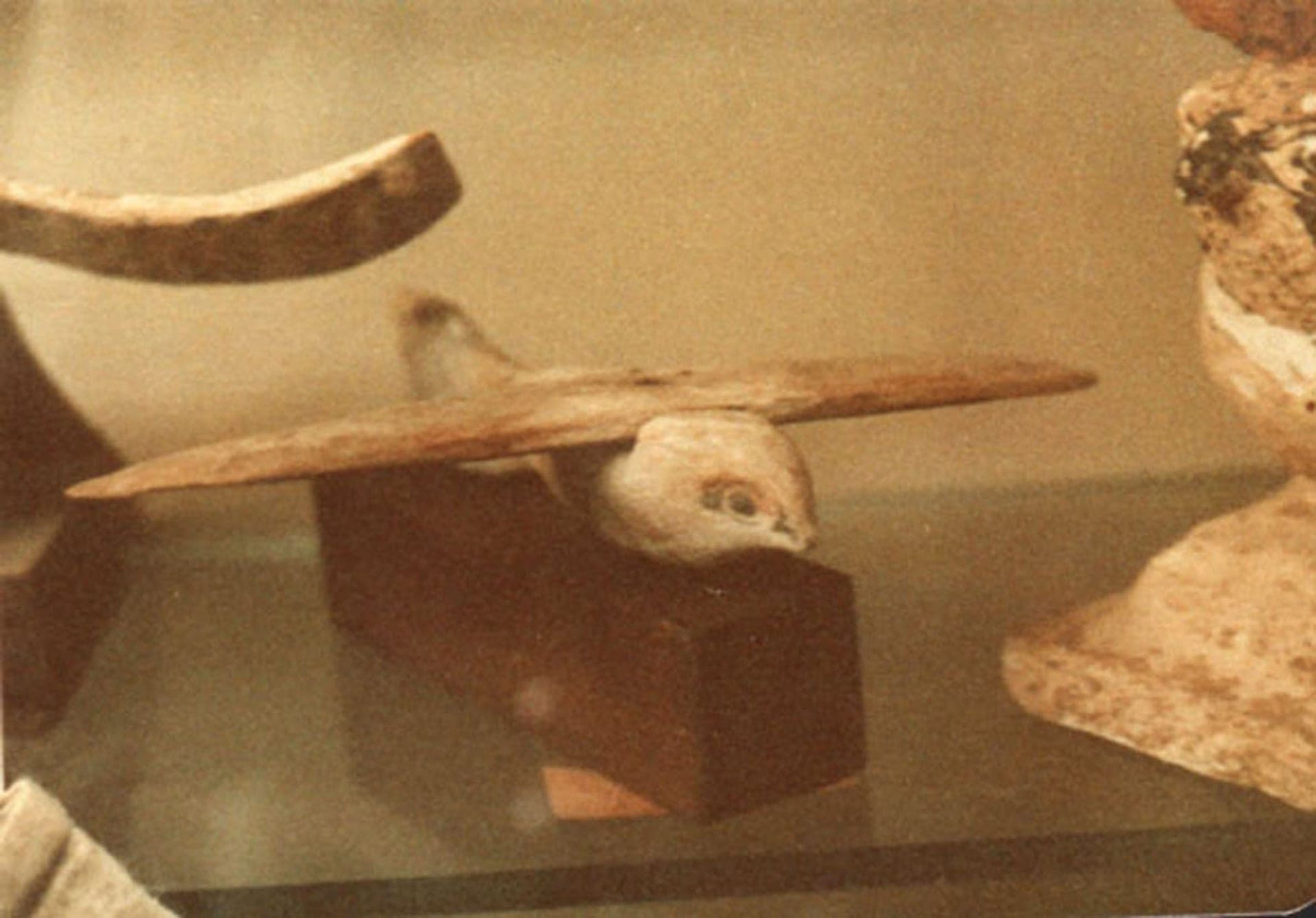
In 1898, archaeologists excavating a burial site at Saqqara, Egypt, recovered a small wooden object that attracted almost no attention at the time.
Fourteen centimeters long with an 18-centimeter wingspan, the sycamore-wood artifact was catalogued as a "bird model" and filed away in the vast collection of the Egyptian Museum in Cairo. Catalog number 6347. For more than seven decades, no one gave it a second glance.
Then, in 1969, an Egyptian physician and aviation enthusiast named Khalil Messiha pulled the artifact from its dusty shelf—and everything changed.
"This is not a bird," he declared. "It is an airplane."
Messiha's argument was bold, and not without basis.
The Saqqara Bird displays several features that are unusual for a natural bird. First, the wings. Bird wings typically curve downward, but the Saqqara Bird's wings extend straight out horizontally—strikingly similar to the main wings of a modern glider. Second, the tail. A bird's tail feathers fan out horizontally, but this artifact's tail fin rises vertically, resembling nothing so much as the vertical stabilizer of an aircraft.
Messiha constructed a scaled-up model from polystyrene foam—six times the original's size—and demonstrated that it could glide through the air. The Egyptian government was intrigued enough to mount a special exhibition at the Cairo Museum in 1972, with the Saqqara Bird as its centerpiece.
Mainstream archaeologists and aeronautical engineers were far less enthusiastic.
The most damning issue is the absence of a horizontal stabilizer. Modern aircraft require both a vertical and a horizontal tail surface for stable flight. The Saqqara Bird has no horizontal stabilizer. Messiha argued that one originally existed but was lost to time. However, no trace of a break or attachment point has ever been found.
In 2006, aerodynamicist Simon Sanderson conducted rigorous wind-tunnel and flight tests on a precise replica. His conclusion was definitive: without an additional horizontal tailplane, the Saqqara Bird cannot sustain stable flight. As-is, it does not fly.
Archaeologists offer a far simpler explanation. Votive falcon figures and weathervanes were common in ancient Egypt. The Saqqara Bird was likely a ceremonial hawk model, a child's toy, or a masthead ornament designed to indicate wind direction on a Nile sailing vessel. The vertical tail makes perfect functional sense as a wind vane.
It is worth noting that no other evidence of aviation technology has ever been found in ancient Egypt—no airfields, no written descriptions of flight, no complementary engineering artifacts. The Saqqara Bird stands entirely alone.
Was the Saqqara Bird truly a scale model of an ancient aircraft? The weight of evidence says no.
But the questions it raises are seductive. Why did a craftsman in 200 BCE carve a bird with unnaturally straight wings and a vertical tail? Was it a weathervane? A toy? Or did someone, 2,200 years ago, look up at a soaring falcon and dare to dream of flight, shaping that dream in sycamore wood?
The truth may be mundane. But the fact that a 14-centimeter wooden carving continues to captivate aviation romantics around the world is, perhaps, the greatest mystery of all.