Metallic spheres found in 2.8-billion-year-old rock in South Africa feature grooved lines and near-spherical shapes. Some claim they are proof of intelligent life predating all known civilizations by billions of years.
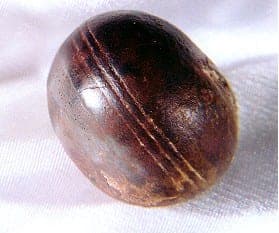
In the Wonderstone Silver Mine near Klerksdorp, North West Province, South Africa, miners began finding peculiar spherical objects in the mid-20th century.
Ranging from 2.5 to 10 centimeters in diameter, the spheres vary in color from dark reddish-brown to bluish-grey. Some are strikingly spherical. A number of them feature one to three parallel grooves running around their equators, as if scored by a precision lathe.
Unusual, certainly—but the real shock lies in their geological context. The pyrophyllite deposits in which the spheres are found were formed approximately 2.8 billion years ago.
Two point eight billion years. At that time, Earth harbored nothing more complex than single-celled microorganisms. Multicellular life was over a billion years in the future. If these spheres are artificial, the entire history of life on Earth must be rewritten.
In 1984, Roelf Marx, curator of the Klerksdorp Museum, made an extraordinary claim. One of the spheres on display in a glass case was rotating on its own axis without any external vibration.
The claim spread like wildfire through alternative history communities. A narrative crystallized: an intelligent civilization that existed 2.8 billion years ago had created these spheres, and some unknown energy source was still powering their rotation after aeons of dormancy.
However, the self-rotation claim has never been scientifically verified. Mundane explanations abound—microscopic vibrations from foot traffic, thermal expansion and contraction of the display case, or simple misperception. No controlled experiment has ever confirmed the phenomenon.
To geologists, the Klerksdorp spheres are not mysterious at all.
They are concretions—natural geological formations in which minerals precipitate concentrically around a nucleus within sedimentary deposits. Similar spherical concretions have been found in sedimentary rocks of all ages around the world. They are, in geological terms, unremarkable.
The spheres are composed primarily of pyrophyllite and goethite (iron oxyhydroxide). The equatorial grooves formed naturally along the boundary between different mineral layers, where differential erosion carved shallow channels over immense timescales.
The claim that the spheres are "perfectly round" does not survive measurement. When systematically examined, most specimens show considerable variation in shape—many are elliptical, oblong, or irregular. The most photogenic and spherical examples were cherry-picked for display and publicity, creating a misleading impression of the collection as a whole.
There is one genuinely interesting feature that even skeptical geologists acknowledge. Some of the spheres are significantly harder than the pyrophyllite host rock surrounding them. The mechanism by which a concretion becomes harder than its enclosing matrix is not fully understood.
But "not fully understood" is not the same as "supernatural." The hardness anomaly is a legitimate question of mineralogical chemistry, not evidence of ancient intelligence.
The Klerksdorp spheres are undeniably beautiful. Their smooth surfaces and regular grooves do look engineered to the untrained eye.
But nature is a master of geometric beauty. Snowflakes form perfect hexagons. Pyrite crystallizes into flawless cubes. Basalt fractures into hexagonal columns. The fact that mineral concretions can form spherical shapes with surface grooves in 2.8-billion-year-old sediment is simply another entry in nature's long portfolio of geometric artistry.
The spheres remain on quiet display at the Klerksdorp Museum. Whether any of them are rotating on their own remains, officially, unconfirmed.