Standing in Delhi for over 1,600 years, this iron pillar has barely rusted. It remains a testament to the astonishing metallurgical skill of ancient India—and a puzzle that modern science only recently began to solve.
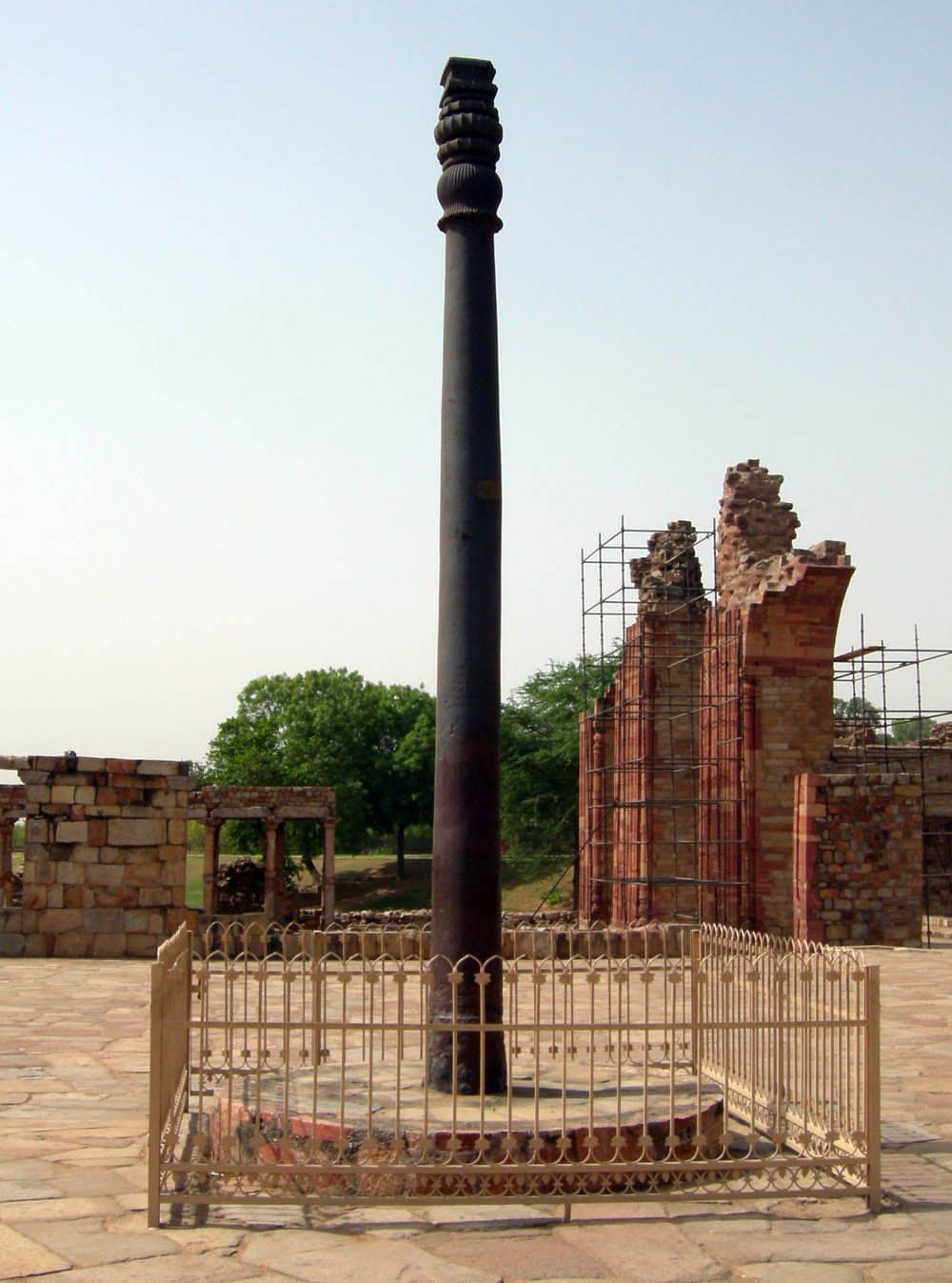
In the courtyard of the Qutub Minar complex in southern Delhi, a single iron column stands in quiet defiance of time.
Rising 7.21 meters from its base and weighing roughly six tonnes, the pillar's surface is a smooth dark grey. There are minor traces of corrosion near the base, but for a piece of iron that has endured more than 1,600 years of monsoons, scorching summers, and Delhi's modern pollution, its condition is nothing short of extraordinary.
A Sanskrit inscription identifies the pillar as a creation of the Gupta dynasty, erected during the reign of Chandragupta II (375-415 CE). Originally a flagstaff dedicated to the Hindu god Vishnu, it is believed to have stood at a different location before being moved to its current site.
When British colonial scholars first examined the pillar in the 19th century, they were stunned.
Europe had only just mastered the mass production of high-quality wrought iron. Yet here stood proof that 5th-century Indian metallurgists had forged a six-tonne column of iron with near-perfect corrosion resistance. Western scientists struggled to explain how this was possible.
Analysis revealed the pillar's iron to be over 98 percent pure—a level of purity that contemporary European blast furnaces could not reliably achieve at such scale. The discovery fueled speculation about lost super-civilizations and secret ancient technologies.
The answer finally came in the early 2000s, when a research team at the Indian Institute of Technology Kanpur cracked the mystery.
The key was a compound called misawite—an iron oxyhydroxide. A protective film just 50 micrometers thick had formed on the pillar's surface over the centuries. This film was created by a chemical reaction between the iron's unusually high phosphorus content and atmospheric moisture.
Ancient Indian ironworkers used charcoal-fueled bloomery furnaces. This traditional smelting process inadvertently introduced high concentrations of phosphorus into the metal. Over time, the phosphorus catalyzed the formation of a natural anti-corrosion coating. It was not deliberate engineering. It was a fortunate byproduct of traditional craftsmanship.
Delhi's climate played a supporting role. The alternating wet and dry seasons created ideal conditions for the protective misawite layer to form and stabilize. In a perpetually humid environment, the pillar might not have fared as well.
Science has explained why the pillar does not rust. But far from diminishing its significance, the explanation amplifies it.
Consider what was required. Forging six tonnes of high-purity wrought iron in the 5th century demanded extraordinary skill. Modern analysis shows the pillar was constructed by forge-welding multiple large iron blooms into a single column—a feat requiring precise temperature control, immense physical labor, and sophisticated organizational capacity.
The Iron Pillar of Delhi may no longer qualify as an inexplicable out-of-place artifact. But it stands as proof that ancient Indian metallurgy was centuries ahead of the rest of the world. The label "OOPArt" has been stripped away by science. What remains is something better: a monument to human ingenuity that has outlasted empires, invasions, and the relentless assault of time itself.
It still stands there today, in the shadow of the Qutub Minar, quietly refusing to decay.