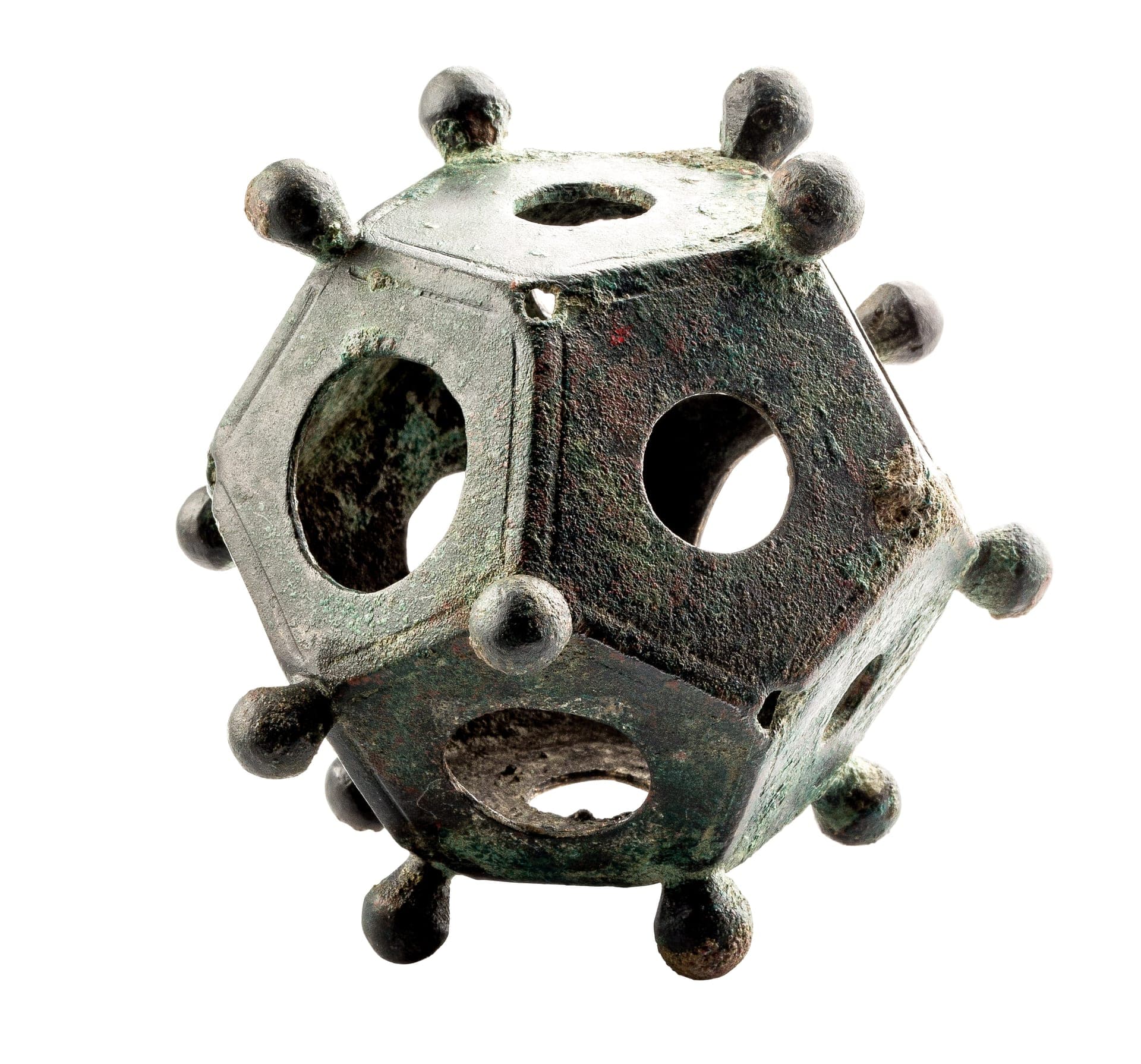
Over 100 bronze dodecahedra have been found across the former Roman Empire. Each face has a different-sized circular hole, and each corner bears a small knob. No one knows what they were for.
The Roman Empire was one of the most meticulously documented civilizations in human history. Laws, architecture, military campaigns, daily life—Romans recorded everything in texts, carved it in inscriptions, and painted it on walls.
And yet, among the artifacts of this record-keeping civilization sits one object that appears in no document whatsoever.
The Roman dodecahedron. A hollow bronze object based on a regular dodecahedron—a geometric solid composed of twelve pentagonal faces. Each face has a circular hole of a different diameter. Each of the twenty vertices bears a small spherical knob. They range from 4 to 11 centimeters in size. Small enough to hold in one hand.
Dated to the 2nd through 4th centuries CE, more than 100 of these objects have been found across Europe. Despite this, not a single Roman text mentions them.
The distribution of Roman dodecahedra reveals a striking geographic bias.
The vast majority have been found in the northwestern provinces of the Roman Empire—modern-day Britain, France, Belgium, the Netherlands, and Germany. Almost none have been recovered from the Mediterranean heartland of Rome or the Italian peninsula.
This pattern suggests the dodecahedra may be connected to provincial cultures—Gallic or Brittonic traditions rather than core Roman civilization. Alternatively, they may relate to the military legions stationed along the empire's northern frontier.
The contexts of discovery are varied. Dodecahedra have turned up in military camps, cemeteries, treasure hoards, and domestic settlement sites. This diversity frustrates attempts to pin down a single function.
Few artifacts attract theories like an object of unknown purpose. The Roman dodecahedron has inspired an extraordinary range of speculation.
Surveying instrument. The holes of different diameters, it is argued, were used to measure the angle of sunlight to determine optimal planting dates. By observing which hole admitted sunlight at what angle, a farmer could gauge the season. However, the hole sizes are not standardized across specimens, undermining the theory of a calibrated measuring device.
Military tool. Suggestions include a range-finding instrument for Roman artillery or a component of a legionary standard. But not all dodecahedra have been found at military sites.
Religious or ritual object. The concentration in the Celtic cultural zone of northwestern Europe has led some to propose a connection to Celtic religious practices or divination. The geometric perfection of the shape may have carried spiritual significance.
Candleholder. Placed knob-side down, the dodecahedra sit stably, and some holes are large enough to accommodate a candle. It is perhaps the most practical hypothesis, but it fails to explain why such an elaborate geometric form was necessary for holding a candle.
Knitting tool. The most viral hypothesis in recent years. Demonstrations on YouTube have shown that yarn can be wound around the knobs and pulled through the holes to knit the fingers of gloves. It works. But working does not mean it was the original purpose.
Why do Roman texts never mention the dodecahedra? This silence may be the most important clue of all.
One possibility is that the objects were so mundane they were not worth recording. But Romans documented everything from spoons to latrines.
Another possibility is that the dodecahedra belonged to a secretive religious cult and were deliberately excluded from written records. Mystery religions like Mithraism were known for their strict prohibition against documenting their rites.
The dodecahedra were cast in bronze using the lost-wax method—a technique requiring considerable metalworking skill. They were not cheap or disposable objects. Someone invested time, resources, and craftsmanship in their production. Whatever they were for, they mattered to the people who made them.
More than 100 specimens exist. The material composition is well understood. The geographic distribution has been mapped. The archaeological contexts have been recorded. And still, no one knows what Roman dodecahedra were used for.
This is unusual. In archaeology, understanding generally improves as more examples of an artifact are found. With the dodecahedra, each new discovery only deepens the mystery.
They sit in glass cases in museums across Europe, small and bronze and silent, patiently absorbing the guesses of every visitor who pauses to wonder. The smallest and most stubborn mystery the Roman Empire ever left behind.