Discovered in 1908 at the Palace of Phaistos in Crete, this clay disc bears 242 stamped symbols that have defied every attempt at decipherment. It remains the Bronze Age's greatest linguistic enigma.
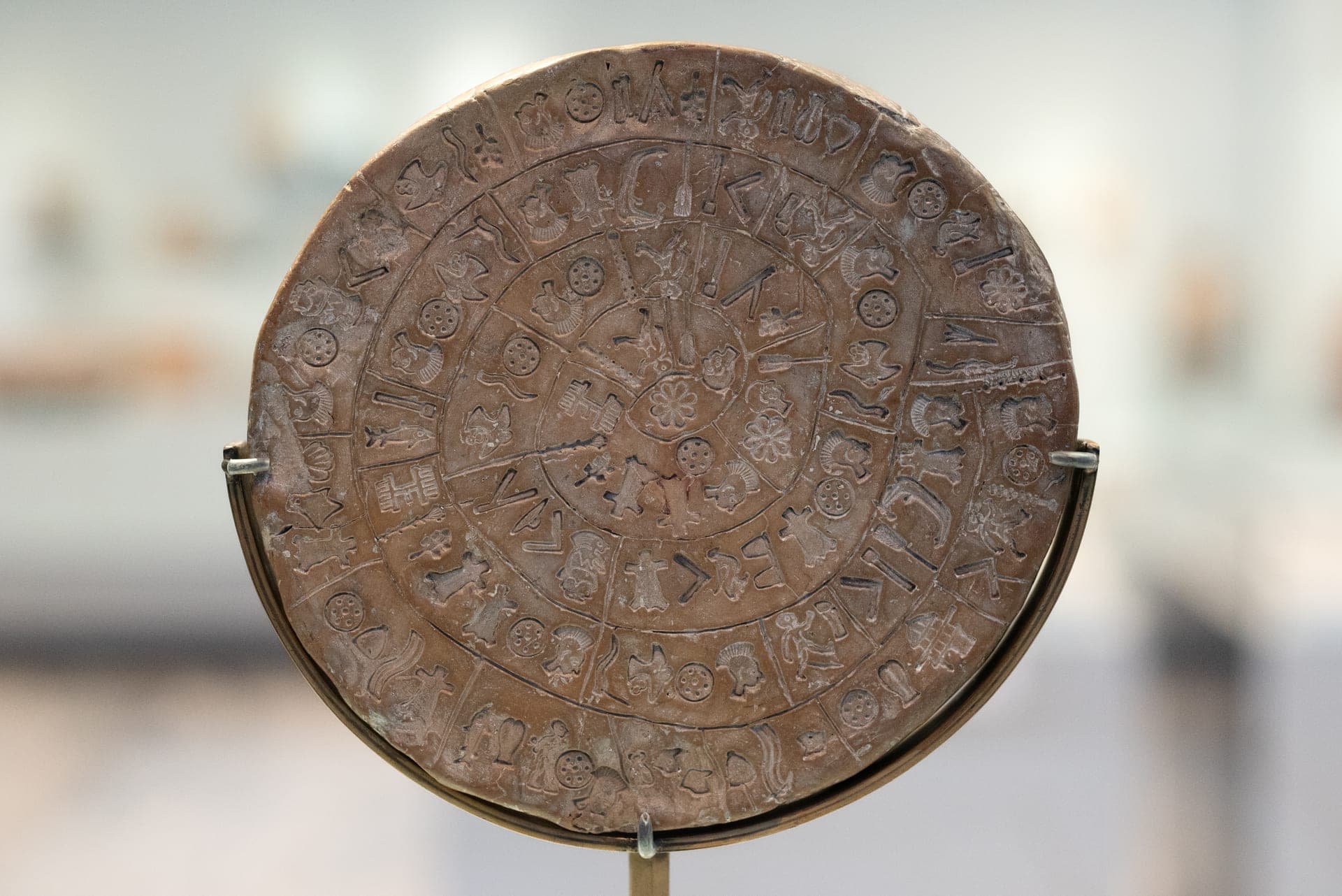
July 3, 1908. Italian archaeologist Luigi Pernier, excavating the Palace of Phaistos on the southern coast of Crete, unearthed a small clay disc that would torment linguists for the next century and beyond.
Roughly 16 centimeters in diameter and two centimeters thick, it fits in the palm of a hand. But the moment Pernier saw the symbols covering both faces, he knew this was no ordinary find.
Arranged in a spiral pattern across both sides of the disc are 242 individual symbols drawn from a repertoire of 45 distinct signs. Human faces, animals, plants, tools, geometric shapes—all rendered with extraordinary precision. And they were not carved by hand. Each symbol was stamped into the wet clay using individual punches.
The implications are staggering. The Phaistos Disc may be the world's oldest example of movable-type printing—predating Gutenberg by more than 3,000 years.
The fundamental reason the Phaistos Disc remains unreadable is the total absence of any comparable text.
Its 45-sign system matches no known writing system. It is not Minoan Linear A. It is not Linear B. It bears no resemblance to Egyptian hieroglyphs or Mesopotamian cuneiform. Every ancient script on Earth has been compared to it. None match.
The problem is compounded by sample size. Just 242 symbols and 45 sign types provide far too little data for meaningful statistical analysis. Frequency analysis—the bedrock of code-breaking—requires substantially more material to yield reliable patterns.
And the most crippling obstacle of all: the Phaistos Disc is unique. No other text using this symbol system has ever been found. Anywhere.
Scholars, linguists, and amateur codebreakers have published more than 100 proposed decipherments to date.
Some declare it a religious hymn. Others insist it is an astronomical calendar. It has been called a board game, a military conscription order, a Minoan prayer, and an early Greek alphabet. One researcher identified it as a legal document. Another claimed it was a greeting to visiting dignitaries.
The problem is that none of these solutions withstand peer review. Without comparative material, even the most sophisticated decipherment is ultimately indistinguishable from creative guesswork.
In 2008, some researchers raised a provocative possibility: could the Phaistos Disc be a modern forgery?
The arguments include anomalies in the clay's firing method compared to typical Bronze Age ceramics, and the puzzling question of why a civilization with such advanced stamping technology left no other examples of its use. If you had movable type, why use it only once?
However, mainstream archaeologists have not embraced the forgery theory. Pernier's excavation records are detailed and consistent, and the stratigraphic context of the find shows no signs of tampering.
The Phaistos Disc sits today behind bulletproof glass in the Heraklion Archaeological Museum, silent and inscrutable.
Approximately 3,700 years ago, someone carefully pressed 45 individual stamps into a disc of wet clay, encoding a message they clearly considered important enough to preserve. Was it a prayer? A record? A story? A song?
The person who wrote it is long dead. The language they spoke has been forgotten. The civilization that created the stamps has crumbled into dust. And the message they so carefully impressed into clay remains exactly what it was on the day Pernier pulled it from the earth: perfectly preserved, and perfectly unintelligible.