Transparent quartz skulls attributed to ancient Mesoamerican civilizations defy the technological capabilities of their supposed era. Their true origins and purpose remain one of archaeology's most contentious mysteries.
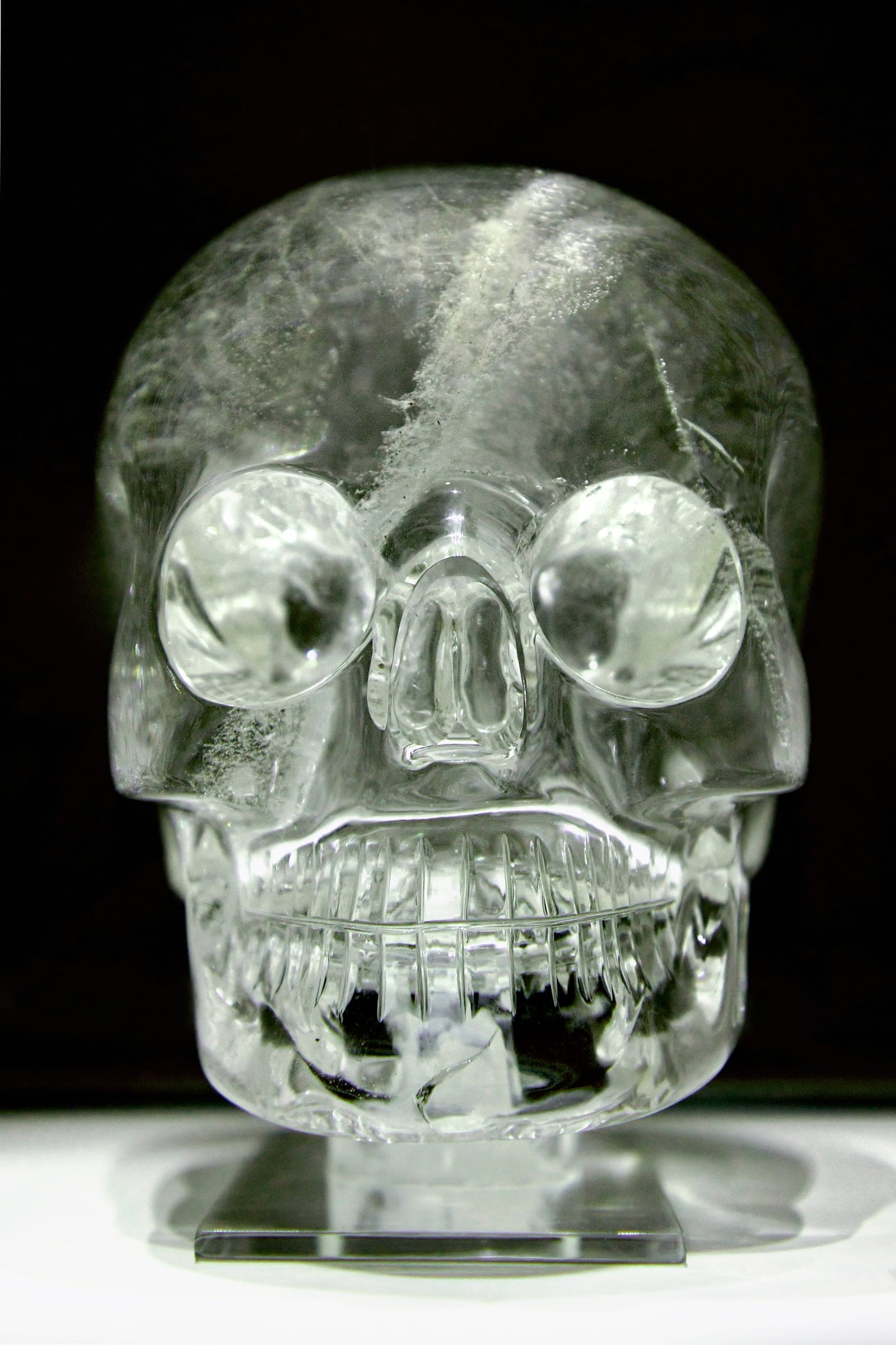
From palm-sized curiosities to life-sized human craniums, they are scattered across museums and private collections worldwide. Skulls carved from flawless, transparent quartz crystal. Beautiful. Eerie. And deeply controversial.
At least a dozen are known to exist. The most famous is the so-called "Skull of Doom," which Anna Mitchell-Hedges claimed to have discovered in 1924 beneath a collapsed altar at the Maya ruin of Lubaantun in what is now Belize. Her adoptive father, the British adventurer Frederick Mitchell-Hedges, would later call it the most dangerous object on Earth.
Weighing roughly five kilograms, the skull is carved from a single block of clear quartz with a detachable lower jaw. When light enters from above, the eye sockets blaze with an unearthly glow. Everyone who sees it for the first time catches their breath.
The central mystery of the crystal skulls has always been their manufacture.
Quartz registers 7 on the Mohs hardness scale—just below diamond. In the 1970s, researchers at Hewlett-Packard's crystal laboratory examined the Mitchell-Hedges skull and reported finding "no evidence of tool marks." The announcement sent shockwaves around the world. Ancient peoples, it seemed, had achieved a level of precision that modern technology could barely match.
The legends multiplied overnight. Relics of Atlantis. Gifts from extraterrestrials. Sources of supernatural healing energy. Prophecies declared that when all thirteen skulls were reunited, the fate of humanity would be forever altered.
Then the 21st century arrived, and science struck back.
In 2008, the Smithsonian Institution and the British Museum subjected their respective crystal skulls to analysis under electron microscopes. The findings were devastating. Both skulls bore unmistakable traces of rotary wheel cutting tools—technology that did not exist before the 19th century. These were not ancient artifacts. They were modern fabrications.
The British Museum's skull was carved from Brazilian quartz and is believed to have been manufactured in Idar-Oberstein, Germany—the world's leading gemstone-cutting center in the late 1800s. Several skulls were traced to a single French antiquities dealer, Eugène Boban, who operated in Mexico City during the 1860s and was known for selling dubious pre-Columbian artifacts to European collectors.
So are they all fakes?
Science has come very close to proving exactly that. But the Mitchell-Hedges skull remains the stubborn outlier. Its owners have consistently refused to allow comprehensive modern testing. That single refusal keeps the flame of belief alive.
Archaeologists point out that no crystal skull has ever been recovered from a documented, controlled excavation. Not one. Every specimen entered the historical record through the murky channels of the 19th-century antiquities trade—a market rife with forgery and fraud.
And yet, the legend persists. Thirteen skulls. Thirteen keys to the future of humanity. The story circulates quietly in corners of the internet, immune to debunking. Whatever the truth, there is something about the cold, luminous gaze of a crystal skull that seizes the human imagination and refuses to let go.