Over 300 stone spheres, some over two meters in diameter and weighing 16 tonnes, have been found in Costa Rica's Diquis Delta. Their near-perfect roundness and purpose remain unexplained.
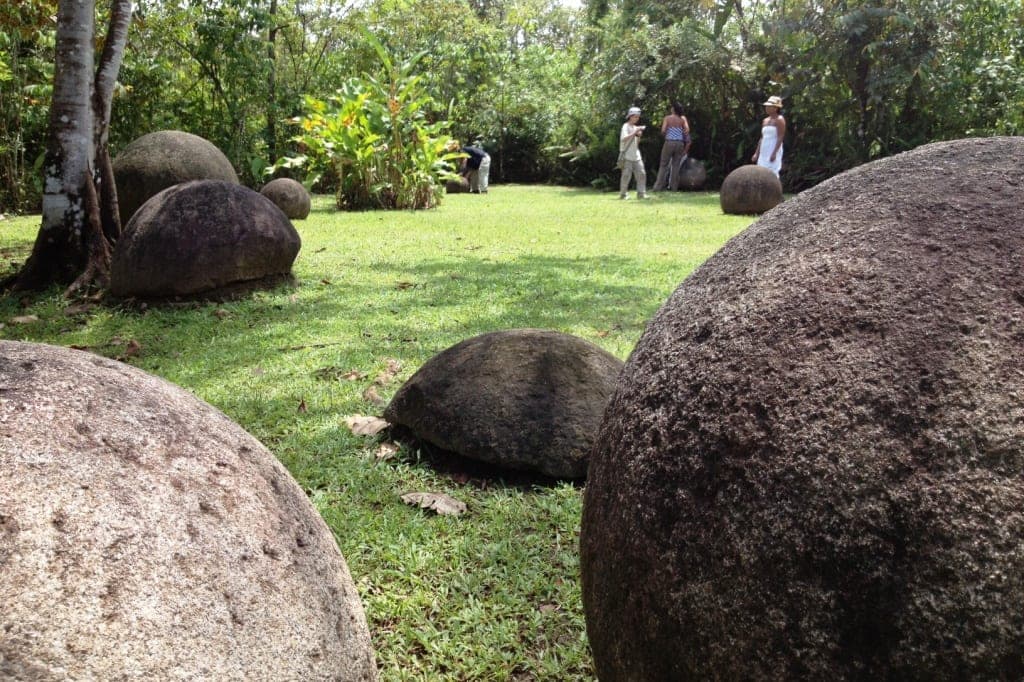
In the 1930s, workers for the United Fruit Company were clearing jungle in the Diquis Delta of southern Costa Rica to plant banana trees when strange objects began emerging from beneath the vegetation.
Stone spheres. Not one or two, but dozens upon dozens.
Scattered across the jungle floor lay stone balls of every size. The smallest could fit in a palm. The largest measured over 2.5 meters in diameter and weighed more than 16 tonnes. And many of them were nearly perfectly round.
More than 300 have been catalogued to date. In 2014, the Costa Rican government secured UNESCO World Heritage status for the stone spheres and the pre-Columbian settlements surrounding them.
Most of the spheres are carved from gabbro, a hard igneous rock similar to granite. The nearest known gabbro deposits lie in the foothills of the Talamanca Mountains, tens of kilometers from where the spheres were found. How a 16-tonne stone was transported across jungle terrain without wheeled vehicles remains an open question.
But the greatest enigma is precision. Surveys using modern measuring equipment have found that the larger spheres achieve roundness within two percent of a perfect sphere. The indigenous people of this region are not believed to have possessed metal tools. How did they achieve such accuracy?
One hypothesis suggests a process of controlled heating and cooling to fracture stone along desired planes, followed by prolonged grinding and polishing with sand. It would have been extraordinarily labor-intensive, but it is not theoretically impossible.
The spheres are attributed to the Diquis culture, which flourished from roughly 800 to 1500 CE. But Spanish conquest eradicated this civilization, and with it, every oral tradition and written record that might have explained the stones' purpose.
To make matters worse, the 1930s plantation clearing displaced many spheres from their original positions. Rumors of hidden gold led treasure hunters to dynamite several stones. The loss of the original placement patterns destroyed what may have been the most important clue to understanding their function.
From the fragmentary evidence that survives, researchers have proposed several explanations. The spheres may have been symbols of chiefly authority and political power. They may have been arranged in astronomically significant alignments. They may have served as boundary markers for public plazas or territorial borders. But none of these theories has been conclusively proven.
Predictably, bolder claims exist.
The spheres were crafted with Atlantean technology. They are alien communication devices. They mark nodes on a planetary energy grid. These theories lack scientific support, but the spheres' seemingly impossible perfection continues to fuel such speculation.
In reality, not all spheres are perfectly round. Natural erosion has deformed many of them, and the myth of flawless sphericity is somewhat exaggerated. But even accounting for erosion, the craftsmanship is remarkable.
The stone spheres of Costa Rica are a voiceless testament to a vanished people.
What they believed, what they intended, why they devoted immense labor to grinding rock into perfect curves—these answers were lost with the civilization that created them. What remains are the spheres themselves, sitting quietly in the green expanse of the Diquis Delta, smooth and round and utterly mute.
The obsession of ancient artisans with perfect form is written on every polished surface. Their reasons for that obsession went with them to the grave.