A Parthian-era artifact from around 250 BC consisting of a clay jar containing a copper cylinder and iron rod, debated as a possible ancient battery.
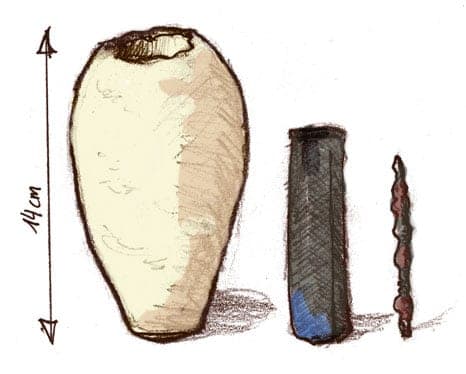
The Baghdad Battery (also called the Parthian Battery) is a set of artifacts discovered near Baghdad, Iraq, in 1936. A clay jar approximately 13 cm tall contained a copper cylinder and an iron rod, sealed with asphalt. It has been dated to the Parthian period (c. 250 BC - 224 AD).
In 1936, German archaeologist Wilhelm Konig studied the artifacts at the Iraq Museum in Baghdad and proposed that they might be galvanic cells (batteries). When filled with an acidic liquid such as vinegar or wine, the jar could reportedly generate approximately 1-2 volts.
Multiple experiments, including those on MythBusters, have confirmed that replicas can indeed generate a weak electrical current. However, the power produced is very small, limiting practical applications. The most popular theory is that they were used for electroplating (gilding with gold or silver), but no ancient Mesopotamian plated artifact has shown evidence of electroplating.