In 1908, a mysterious explosion equivalent to 1,000 Hiroshima bombs flattened 2,000 square kilometers of Siberian forest. No crater and no debris were ever found.
June 30, 1908. 7:17 AM. Over the remote Tunguska River basin in central Siberia, the sky cracked open.
Hundreds of kilometers away, villagers watched a light brighter than the sun streak across the northern horizon. Seconds later, a monstrous shockwave shook the earth, shattering windows and knocking people off their feet. Barographs as far away as London registered the atmospheric disturbance.
Yet the people closest to ground zero—Evenki reindeer herders—were blown out of their tents but miraculously survived. Their accounts would baffle scientists for decades to come.
"The sky split in two, and a pillar of fire descended."
Remarkably, the largest explosion in recorded history went uninvestigated for 19 years.
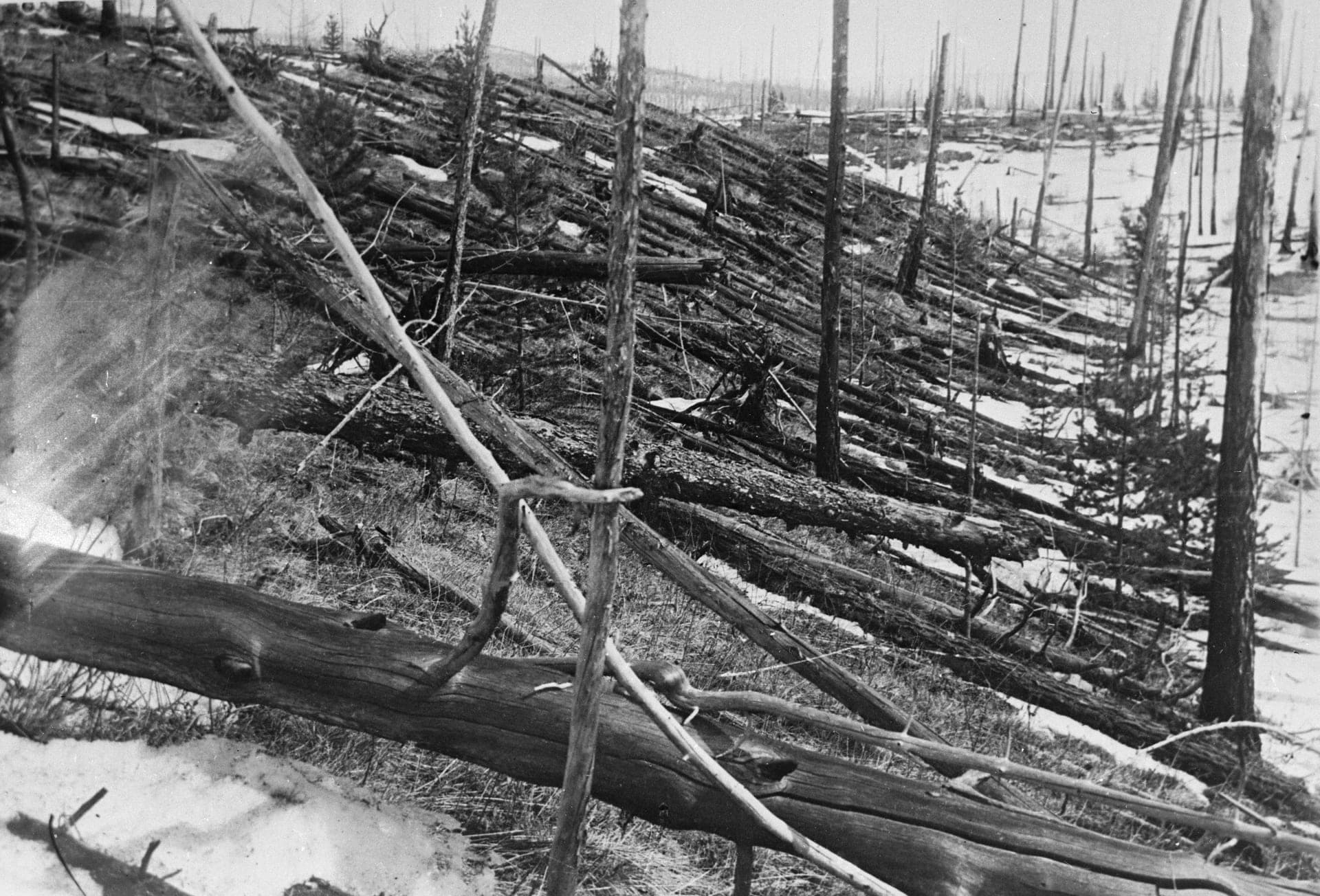
In 1927, Soviet mineralogist Leonid Kulik finally led an expedition to the blast site. What his team found defied comprehension. Approximately 2,150 square kilometers of forest—an area the size of Tokyo—had been flattened in a radial pattern. Eighty million trees lay toppled, all pointing outward from a common center.
But the greatest mystery lay in what was absent. Despite the staggering destruction, there was no impact crater.
Modern analysis estimates the Tunguska explosion released 10 to 15 megatons of energy—roughly 1,000 times the Hiroshima bomb. Had it occurred over Moscow or New York, the city would have been erased from existence.
The blast is believed to have occurred at an altitude of 6 to 10 kilometers above the surface. This "airburst" explains why no crater was formed.
More than a century later, the true cause of the Tunguska Event remains contested.
The most widely accepted hypothesis holds that an asteroid or comet fragment, roughly 60 to 190 meters in diameter, entered the atmosphere and detonated before reaching the ground. The 2013 Chelyabinsk meteor, though far smaller, demonstrated that this mechanism is very real.
But the scarcity of physical evidence has left room for bolder theories—antimatter collisions, miniature black holes, and even a misfire from Nikola Tesla's Wardenclyffe Tower. Whatever the truth, the scars left on the Siberian taiga remain a humbling reminder that the forces of the cosmos far exceed human imagination.

Fallen trees near the Tunguska blast epicenter, photographed by Kulik's 1927 expedition. Even 20 years after the explosion, the trees remained toppled.
Source: Wikimedia Commons

Article from the Siberian newspaper 'Sibirskaya Zhizn' dated July 29, 1908 — one of the earliest press reports of the Tunguska explosion.
Source: Wikimedia Commons