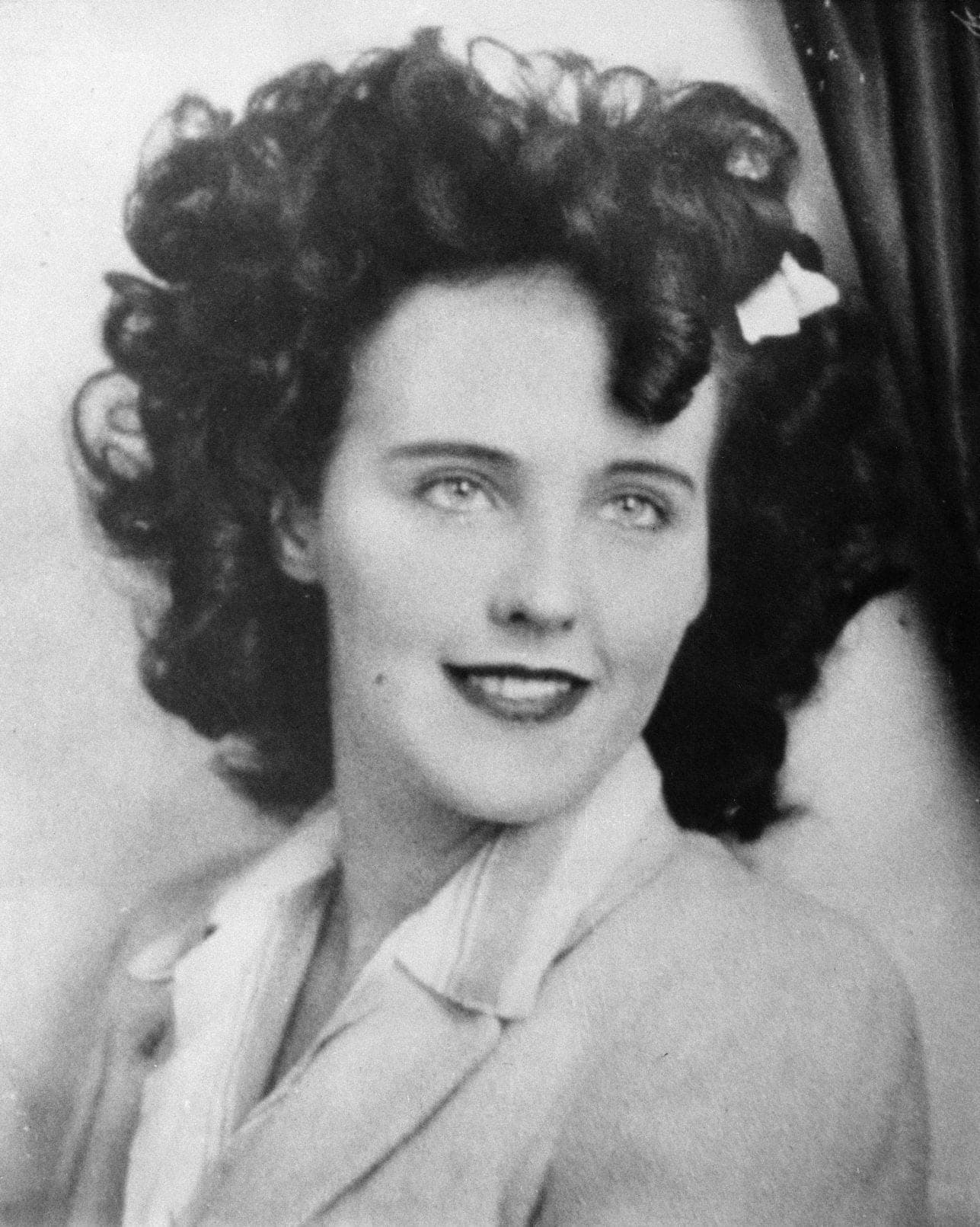
In 1947, aspiring actress Elizabeth Short was found bisected with surgical precision in a Los Angeles vacant lot. The case became America's most infamous unsolved murder.
January 15, 1947. The Leimert Park neighborhood of Los Angeles. Betty Bersinger was walking her three-year-old daughter along their usual route when something white caught her eye in a vacant lot at the corner of 39th Street and Norton Avenue.
She thought it was a mannequin. Store display pieces sometimes ended up in empty lots. But as she drew closer, the truth hit her like a freight train.
It was a woman. Cut completely in half at the waist.
Elizabeth Short, 22 years old, lay in two pieces on the dewy grass. Her body had been completely drained of blood. Her face bore deep cuts from each corner of her mouth to her ears — a mutilation known as a "Glasgow smile." The body had been carefully washed, and the two halves were positioned with deliberate, almost ceremonial precision.
This was not a crime of passion. This was a performance.
Elizabeth Short was a young woman from Medford, Massachusetts, who had come west chasing the Hollywood dream. She never made it onto the silver screen.
With her jet-black hair, porcelain skin, and preference for black clothing, regulars at a local drugstore had nicknamed her the "Black Dahlia" — a play on the 1946 film The Blue Dahlia. When the murder hit the papers, that nickname became the headline.
And the headline became a legend.
The Los Angeles Police Department launched the largest investigation in its history. Over 150 suspects were questioned. More than 60 people came forward to confess — all were lying.
The killer's methods pointed to someone with medical training. The bisection had been performed precisely at the lumbar vertebrae, through the intervertebral disk — a cut that required anatomical knowledge. The complete exsanguination indicated the murder had been committed elsewhere, with time and preparation.
Days after the discovery, an envelope arrived at the Los Angeles Examiner. Inside were Elizabeth's belongings: her address book, business cards, and photographs. Everything had been washed with gasoline. No fingerprints.
The sender had pasted words cut from newspapers onto the envelope. The message read: "Here is Dahlia's Belongings. Letter to Follow." The promised letter never came.
Decades of investigation have produced a roster of suspects but no conviction.
Dr. George Hodel, a prominent Los Angeles physician, became the most discussed suspect after his own son, Steve Hodel — a retired LAPD homicide detective — published a detailed case naming his father as the killer. George Hodel had the surgical skill, the temperament, and had been investigated by police at the time. His Hollywood home was even bugged by detectives who reportedly overheard incriminating statements.
Other suspects include Mark Hansen, a nightclub owner who had housed Elizabeth; Leslie Dillon, a bellhop with an unsettling knowledge of the case; and an unnamed Cleveland doctor linked to the "Torso Murders" of the 1930s.
But the physical evidence has never been sufficient to close the case.
More than seven decades later, the Black Dahlia case remains officially open. The LAPD files are sealed, periodically reviewed, and returned to storage.
Elizabeth Short came to Los Angeles looking for stardom. She found immortality instead — not as the actress she dreamed of becoming, but as the victim at the center of America's most enduring murder mystery. In the fog of postwar Los Angeles, she remains forever twenty-two, still waiting for justice that may never come.