On Christmas Eve 1945, a house fire in West Virginia left five Sodder children missing. But no remains were ever found in the ashes. Did they really die in the fire — or were they taken?

Just past midnight on December 24, 1945, a fire broke out at the home of George and Jennie Sodder in Fayetteville, West Virginia. Of their ten children, the parents and four kids managed to escape. But five — Maurice (14), Martha (12), Louis (9), Jennie (8), and Betty (5) — were trapped on the second floor.
George ran outside to grab the family's ladder, which was always kept against the wall. It was gone. The ladder was later found hidden by an embankment some distance from the house. Both of the family's trucks had worked perfectly the day before; that night, neither would start. Both engines had been disabled.
The official cause was ruled a wiring fault. But the Christmas lights remained on as the fire spread — the very lights that should have gone dark instantly if a short circuit had triggered the blaze. The phone line, leading away from the house, had been cleanly severed in a way that could only be deliberate.
The fire consumed the entire house in less than an hour. By the time firefighters arrived, only ash remained. Authorities concluded the heat had completely cremated the five children's bodies. Jennie Sodder rejected this — and an undertaker she consulted backed her up. He told her that human bones can survive being burned at 2,000°F (about 1,090°C) for two full hours and remain identifiable. The Sodder house fire didn't last an hour, and never reached cremation temperatures. Yet metal kitchen appliances and bedsprings were found intact in the wreckage. Not one bone fragment, not one tooth, from five children.
From this point on, the Sodders refused to accept that their children had died at all.
The fire department, just a few kilometers from the house, took six to eight hours to respond. The fire chief later explained the delay by saying he didn't know how to drive the fire truck — an explanation that made the case more disturbing, not less.
Two years later, after the parents petitioned for help, the FBI agreed to investigate. But local police and fire authorities refused to grant the federal authorities the jurisdiction they needed. Without that local consent, the FBI could not proceed. The decision to block them, made by the same officials who had answered the fire, raised the disturbing possibility that the local response had been compromised from the start.
What kind of force could silence a small-town police force and fire department? The most persistent answer points at organized crime.
George Sodder, an Italian immigrant, had been openly critical of Mussolini and the Italian fascist movement, and had drawn lasting hostility from segments of the local Italian-American community as a result. Weeks before the fire, a stranger came to the house asking pointed questions about the children's bedroom layout. Another man threatened George directly: "Your house will go up in smoke." Neighbors reported an unfamiliar car parked across the road in the days leading up to Christmas Eve, with men inside who appeared to be watching the family.
A coordinated act — cutting the phone line, hiding the ladder, sabotaging both trucks, then arranging that the local fire response would be slow enough and the federal investigation blocked — fits the Mafia kidnapping theory in a way no accidental house fire ever could.
George and Jennie spent every dollar they had on private investigators, refusing to believe their children were dead. In 1952, they erected a massive billboard along Route 16, displaying portraits of the five missing children and offering $10,000 for information — an extraordinary sum at the time. The billboard stood there for decades.
In 1968, an anonymous letter arrived from Kentucky. Inside was a photograph of a man in his twenties. On the back, handwritten: "Louis Sodder." George and Jennie believed the man's dark brown eyes, the angle of his nose, and the tilt of his left eyebrow matched their son's. They sent a private investigator to follow up. The trail went cold immediately.
George Sodder died in 1969. Jennie died in 1989. Neither ever learned what had happened to their children. Their youngest surviving daughter, Sylvia — who escaped the house that night — has insisted to this day that her brothers and sisters did not die in the fire.
The billboard in Fayetteville is gone now. But the question it asked — "Do you have any information?" — still hangs in the air, almost eighty years after Christmas Eve, 1945.
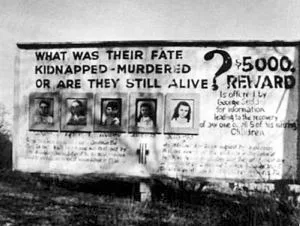
The billboard erected by George and Jennie Sodder along Route 16 in West Virginia in 1952, displaying photographs of the five missing children and offering a reward (initially $5,000, later raised to $10,000) for information. It stood for decades and became one of the most recognizable symbols of the case.
Source: Public Domain (1952 publicly displayed billboard)

The anonymous photograph received from Kentucky in 1968. The Sodder parents — citing the dark brown eyes and the angle of the nose and left eyebrow — believed the young man depicted was their son Louis, grown up. A private investigator was dispatched, but the trail went cold.
The official conclusion was death by fire, but the Sodder family rejected it. Their alternative theory — that the children were abducted and the fire was used as cover — was supported by a string of unexplained anomalies: a cut phone line, a missing ladder, a stalled engine on the family truck, and a disturbing visit from a stranger weeks earlier.
No. As of today the five missing Sodder children — Maurice, Martha, Louis, Jennie, and Betty — have never been positively identified, alive or dead. Their parents George and Jennie Sodder spent the rest of their lives investigating leads, including alleged sightings into the 1960s, but no claim was ever conclusively verified.
It has never been proven that they did. The 1945 Christmas Eve house fire in Fayetteville, West Virginia burned the home to the ground in roughly 45 minutes, yet investigators found no human remains in the ashes — no bones, teeth, or organic residue. Forensic experts later said an ordinary house fire of that duration could not have fully consumed five bodies.
The official cause was faulty wiring, but this conflicts with documented facts: the Christmas lights were still on after the fire started (which would not happen if the wiring had failed), and the family had been told only days earlier that their home had been recently inspected and approved. No definitive cause has ever been established.
Yes. George and Jennie Sodder erected a billboard along Route 16 near Fayetteville, West Virginia, displaying photographs of the five missing children and offering a reward for information. It stood for decades and became one of the most recognizable symbols of the case.