President Kennedy was assassinated in Dallas on November 22, 1963. Despite the official lone-gunman verdict, theories of a second shooter and government conspiracy have persisted for over sixty years.
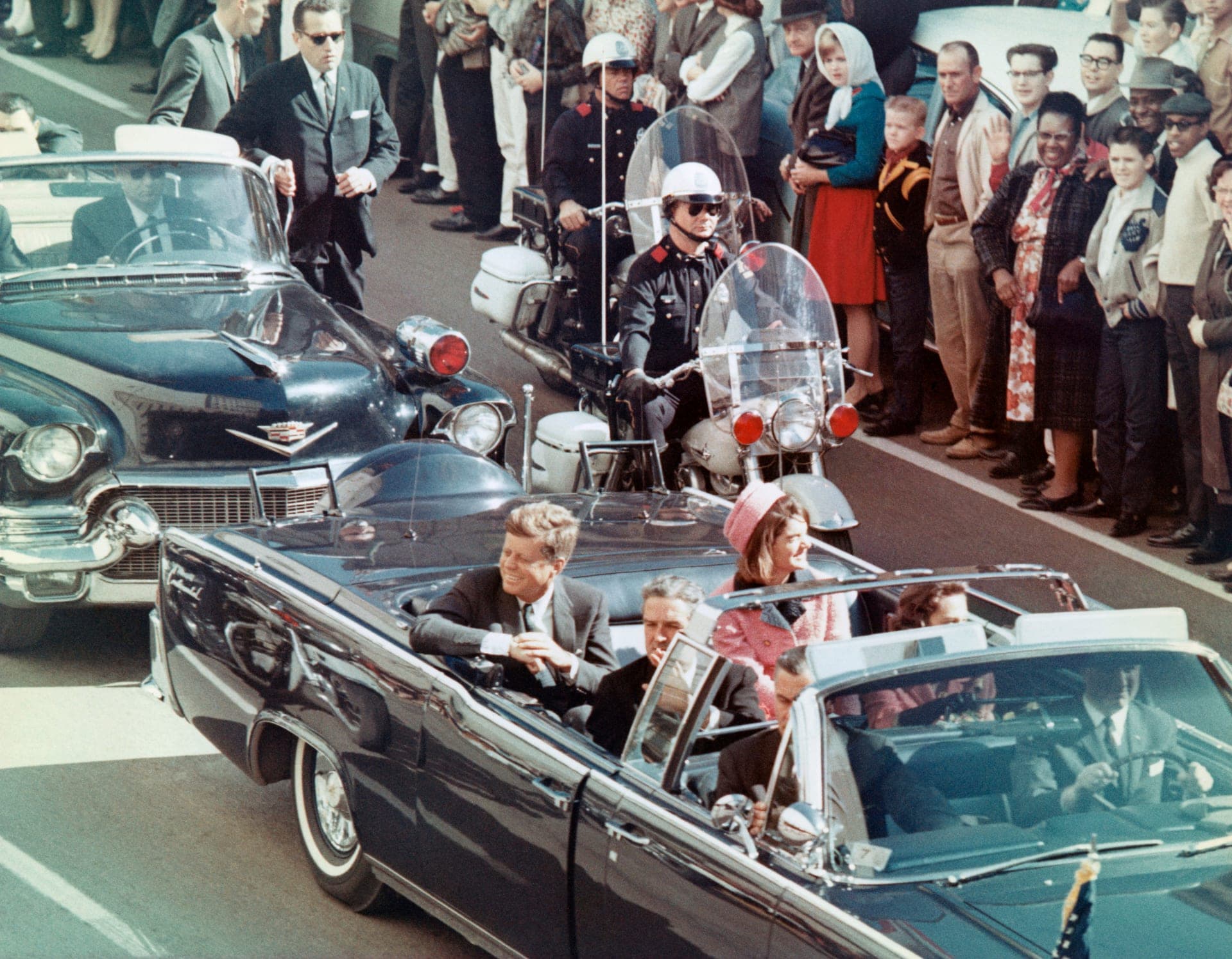
November 22, 1963. Just past noon. The crack of rifle fire echoed through Dealey Plaza in Dallas, Texas.
President John F. Kennedy, riding in an open-top Lincoln Continental beside his wife Jacqueline, slumped forward. The moment was captured on an 8mm home movie camera by Abraham Zapruder, producing what would become one of the most scrutinized pieces of film footage in history.
At 1:00 PM, the 35th President of the United States was pronounced dead at Parkland Memorial Hospital. He was 46 years old.
The Warren Commission, established just days after the assassination, spent ten months investigating. Its conclusion: Lee Harvey Oswald, acting alone, fired three shots from the sixth floor of the Texas School Book Depository using an Italian-made Carcano M91/38 rifle.
America was not convinced. In poll after poll, a majority of Americans have consistently expressed belief that a conspiracy was involved.
At the heart of the skepticism lies the so-called "magic bullet" theory. According to the Commission, a single bullet passed through Kennedy's back and throat, then struck Governor John Connally seated in front, wounding his back, chest, wrist, and thigh.
To critics, this trajectory seemed physically impossible. However, modern ballistic simulations have shown that when the actual seating positions are accurately reconstructed, the single-bullet trajectory is in fact consistent with the laws of physics.
Multiple eyewitnesses reported hearing shots from a direction other than the Book Depository. Many pointed to the grassy knoll, a small rise ahead of the motorcade in Dealey Plaza. Some claimed to have seen a puff of smoke.
If a second shooter had been positioned on the grassy knoll, the lone-gunman theory would collapse entirely. In 1976, the House Select Committee on Assassinations (HSCA) analyzed acoustic evidence and concluded that the assassination was "probably the result of a conspiracy." This acoustic analysis, however, was later challenged and rejected by the National Academy of Sciences.
What made the case even more disturbing was what happened two days later. While being transferred under police custody, Oswald was shot dead on live television by Jack Ruby, a Dallas nightclub owner.
Oswald never stood trial. Ruby claimed patriotism as his motive, but investigators later uncovered his connections to organized crime. Was it a silencing? The answer died with both men.
Note: The following conspiracy theories are presented as cultural phenomena. They do not represent the mainstream historical or scientific consensus.
CIA involvement. A Mafia hit. The military-industrial complex. Castro's retaliation. Even Vice President Lyndon Johnson has been named as a suspect. The theories are endless. Yet most mainstream historians conclude that the physical evidence supports Oswald as the lone gunman.
Since 2017, previously classified documents have been gradually released to the public, but no definitive new evidence has emerged. Still, the JFK assassination remains the foundational event of American conspiracy culture, the moment that shattered public trust in government and gave birth to a new way of questioning power.
The shots fired in Dealey Plaza still echo. Not because we lack answers, but because for millions of people, the official answer has never been enough.