Is Alaska's ionospheric research facility HAARP a weather weapon? Conspiracy theories claim it can trigger earthquakes and control minds. The truth is far less dramatic — but the rumors persist worldwide.
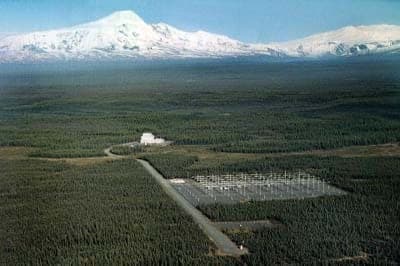
Gakona, Alaska. Roughly 320 kilometers northeast of Anchorage, in a stretch of remote wilderness, 180 high-frequency antennas stand in precise rows, pointing skyward.
HAARP: the High-frequency Active Auroral Research Program. The official name means little to most people. But in the world of conspiracy theories, this facility is arguably one of the most feared places on Earth.
HAARP was launched in 1993 as a joint project of the U.S. Air Force and Navy. Its purpose: to study the ionosphere, the electrically charged layer of atmosphere stretching from roughly 80 to 600 kilometers above the Earth's surface.
The facility transmits high-frequency radio waves into the ionosphere and observes the resulting interactions. The data gathered helps improve communications technology and navigation systems. Since 2015, the facility has been transferred to the University of Alaska Fairbanks and operates as a purely academic research station.
Its maximum output is 3.6 megawatts. That sounds like a lot, but compared to the energy the sun pours into the ionosphere every second, it is quite literally a drop in the ocean.
Note: The following conspiracy theories have no scientific basis. They are presented as cultural phenomena.
HAARP became a conspiracy target in the mid-1990s, sparked by a book by Nick Begich and Jeane Manning that claimed the facility was a secret weather-manipulation weapon.
Since then, HAARP has been blamed for virtually every major natural disaster on the planet. The 2004 Indian Ocean earthquake. The 2010 Haiti earthquake. The 2011 Tohoku earthquake and tsunami. Hurricane Katrina. Tornadoes. Droughts. Every time a catastrophic natural event occurs somewhere in the world, social media fills with posts declaring it "HAARP's doing."
Some theorists go further, claiming HAARP can manipulate the human mind. Electromagnetic waves, they say, can be used to control emotions and keep the population docile.
Meteorologists and physicists have consistently rejected these claims. HAARP's power output is orders of magnitude too small to manipulate weather systems. Triggering earthquakes is physically impossible with radio waves. The facility's effect on the ionosphere is highly localized and temporary, and no mechanism exists by which it could influence surface weather.
Moreover, HAARP's research findings are published in peer-reviewed journals, and the facility holds an annual open house for the general public. For a secret weapon, it is remarkably transparent.
Several factors explain HAARP's enduring appeal as a conspiracy target. Ionospheric research is an unfamiliar field that sounds mysterious and vaguely threatening. The military's involvement as an early funder raises suspicion. And the sheer destructive power of natural disasters creates a psychological need for someone to be responsible. "Someone did this on purpose" is, for many, an easier thought to bear than "nature is random and indifferent."
The 180 antennas at Gakona continue to beam radio waves into the Alaskan sky, studying the ionosphere in the name of science. Or something more? Scientists are unequivocal in their answer, but conspiracy theorists remain unconvinced.